
App Marketing Automation: What It Is and How to Use It as a Solo App Founder
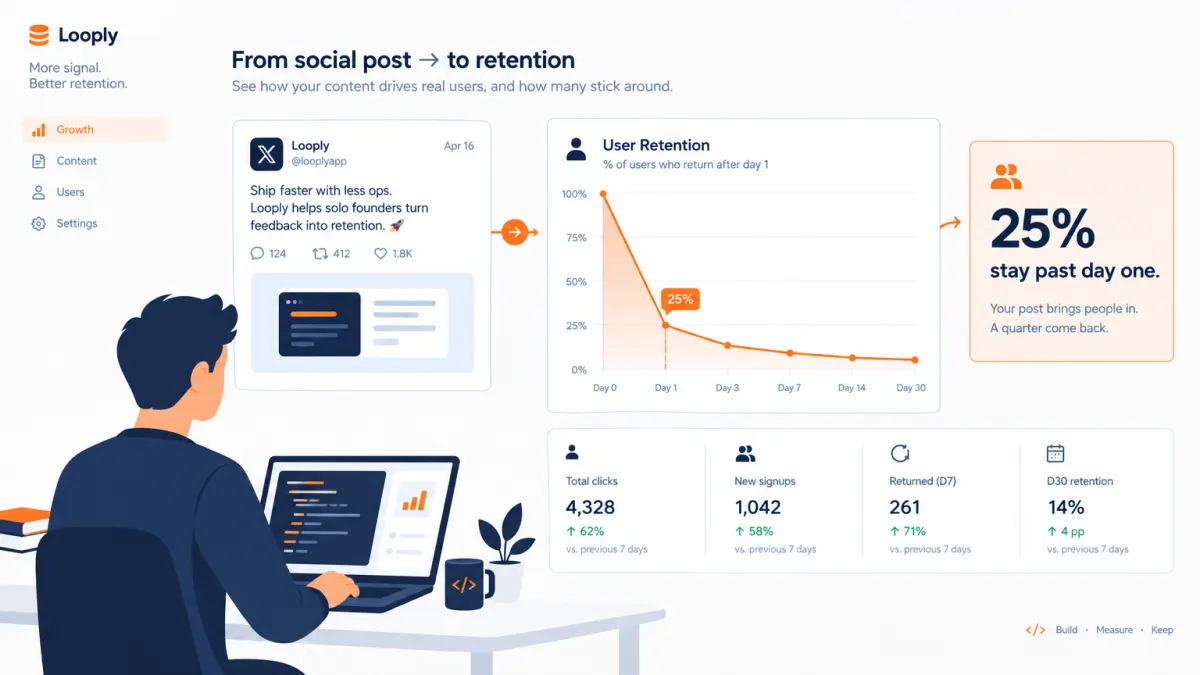
App marketing automation is the practice of using software to plan, create, schedule, and measure marketing activity for a mobile or web app, without a human marketer doing each task manually.
For a solo app founder, that definition matters because the alternative is either hiring someone you cannot afford or spending hours every week on channels you have not had time to learn. Automation does not replace judgment. It handles the repetitive execution so your judgment goes further.
This post covers what app marketing automation actually includes, where most tools fall short, and what it looks like when the system is connected end-to-end, from a published post to whether the user it brought in is still active thirty days later.
What does app marketing automation cover?
App marketing automation covers the channels and tasks that repeat every week: writing and scheduling social posts, identifying SEO and AI-search topics, creating content for gaps on your site, optimizing your app store listing, and managing email sequences for new users.
Each channel has its own cadence:
- Social (Facebook, LinkedIn, others): Posts written, scheduled, and published on a set calendar. Each post links back to a page on your site.
- SEO and AI search: Topic suggestions based on what your site already covers and what it is missing. New content drafted for uncovered topics.
- App store optimization (ASO): Title, subtitle, keyword field, and description kept current as category competition shifts.
- Email: Onboarding and re-engagement sequences triggered by what users do (or stop doing) inside the app.
- Paid ads: Creative and copy variations tested against install and retention data, not just click-through rate.
The common thread is that none of these tasks requires a human to start from scratch each time. Automation handles the drafting, scheduling, and publishing. You review what matters and approve it.
Where do most app marketing tools fall short?
Most app marketing tools cover one channel and stop at a surface metric: likes, installs, open rates. They do not connect what happened in marketing to what happened inside the app afterward.
That gap is the real problem. An install is not a user. A user who opens the app once and never returns costs you acquisition spend and tells you nothing useful. If your marketing tool cannot tell you that the Facebook post from Tuesday brought in twelve users and nine of them are still active, you are optimizing for the wrong number.
The result is a loop that does not close: you publish content, you see installs go up or down, and you have no reliable way to know which effort caused which outcome. So you keep doing roughly the same things and hope the trend is positive.
App marketing automation that is worth using connects each marketing action to downstream user behavior, using your own analytics, not a third-party attribution black box.
What do the numbers say about app marketing automation and retention?
The data on mobile app retention makes the case for connected automation more clearly than any feature list.
Average mobile app retention falls to roughly 25% after day one and drops below 10% by day thirty (Adjust, 2024 Mobile App Trends). That means for every hundred users a marketing campaign brings in, fewer than ten are still active a month later, and most marketing tools are measuring the hundred, not the ten.
For solo founders, the practical implication is this: automating the wrong metric at scale makes the problem worse faster. Automation connected to retention data, where the system puts more effort into channels and content that bring in users who stay, compounds in the right direction instead.
How does Appcmo implement app marketing automation?
Appcmo is an AI CMO that plans and runs app marketing across social, SEO, app stores, email, and ads. The difference from a channel tool is that it connects each piece of marketing work to what the users it brought in actually did inside the app, using your own Amplitude analytics, not a separate attribution layer.
Here is how it works in practice:
- Weekly planning meeting: You chat with the AI CMO, review what it is proposing for the week, and approve or adjust. The meeting is designed to take about thirty minutes.
- Automated execution: Approved social posts are written, scheduled, and published. Each post links to a page on your site. SEO and AI-search topic suggestions are generated based on your existing content. New content is drafted for gaps.
- Measurement through your own analytics: Results feed back through your Amplitude account. The system sees which posts and pages brought in users, and which of those users stayed.
- Compounding effort: The next week’s plan puts more weight on what worked: not just what got clicks, but what brought in users who are still active.
- Founder control: You choose how much freedom the CMO has. Cautious means it asks before acting. Independent means it executes and reports. Neutral is in between. The decisions that matter still come to you.
Appcmo does not publish pages to your website. It writes them and you publish. It does not pay for your AI usage or ad spend. It runs on your own accounts and keys, billed to you directly with no markup. Access is currently invite-only through the waitlist.
Get app marketing automation that measures who stays, not just who clicks
If you are building a B2C app without a marketing team, Appcmo runs the execution and brings the results back to you in a thirty-minute weekly meeting. Social, SEO, app stores, email, and ads, all planned, executed, and measured against whether the users it brings in actually stay.
Access is invite-only. Join the waitlist to get early access.
Join the waitlist →Frequently asked questions about app marketing automation
What is app marketing automation?
App marketing automation is software that plans, creates, schedules, and measures marketing activity for a mobile or web app without requiring a human marketer to handle each task manually. It typically covers social media, SEO content, app store optimization, email, and paid ads.
Does app marketing automation work for solo founders with no marketing background?
Yes. The purpose of automation is to handle the repetitive execution (writing posts, scheduling content, generating topic suggestions) so a founder without marketing experience can focus on approving decisions rather than doing the work from scratch. The key is choosing a system that explains its reasoning and keeps the founder in control of what goes out.
What is the difference between app marketing automation and a channel tool like a social scheduler?
A channel tool handles one channel and typically stops at a surface metric: likes, reach, or installs. App marketing automation, at its most useful, connects activity across channels and measures downstream outcomes: not just whether a post got clicks, but whether the users it brought in are still active in the app thirty days later.
How much time does app marketing automation require from a founder?
It depends on the system. Appcmo is designed around a weekly planning meeting of roughly thirty minutes. The AI CMO handles drafting, scheduling, and publishing. The founder reviews recommendations, approves what goes out, and sees results, without needing to manage individual tasks across channels.
Does app marketing automation improve user retention?
Automation alone does not improve retention. Automation connected to behavioral data does. The system needs to know what users are doing inside the app, not just whether they installed it, to put effort into the right places.